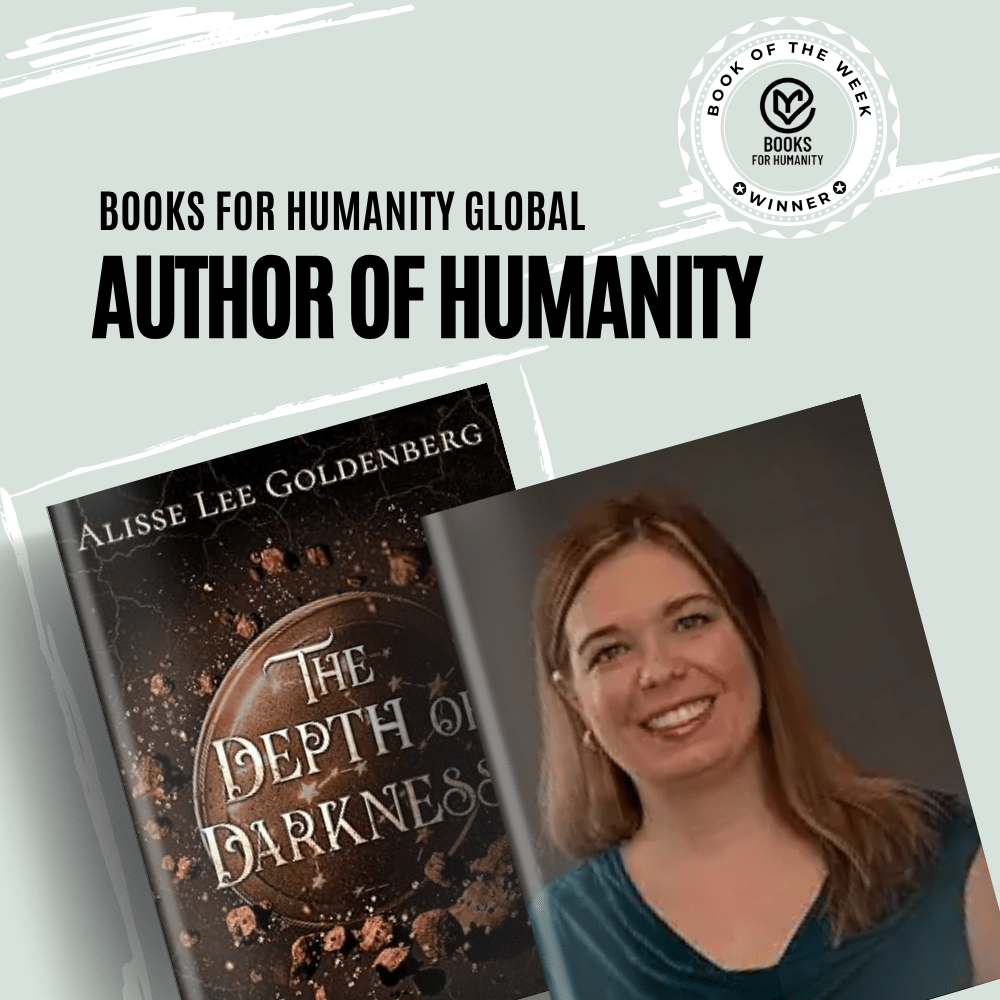
Alisse Lee Goldenberg is a Canadian author, screenwriter, and playwright whose work spans children’s literature, fantasy, horror, and young adult fiction. She is the creator of several interconnected fantasy series, including The Sitnalta Series, The Children of Colonodona, and The Dybbuk Scrolls. In this interview, Goldenberg discusses the creative journey behind her latest novel, the conclusion of a long-running fantasy saga, her approach to building characters and worlds across multiple books, and the experiences that continue to shape her work and perspective as a storyteller.
Alisse, thank you for joining us. To begin, could you introduce yourself to our readers, share a little about your background, what you do, and what you hope to accomplish through your work?
I am a Toronto-based author of middle grade fiction, young adult fantasy romance, and horror. I am also a playwright and screenwriter. My goal is to allow everyone to be able to find themselves in fiction or on the stage. I believe that everyone has a story worth telling, and, having grown up a voracious reader, I want to give that back to people.
Your latest novel concludes a story world that has developed across multiple books. What inspired you to return to this setting and bring this chapter of the journey to its conclusion?
The Sitnalta Series and The Children of Colonodona have always had a set ending in my mind. For me, without giving too much away, I viewed these characters’ stories as a cycle. I wanted the chance for everyone to find their full-circle moment, whether it’s happy, sad, or bittersweet.
It’s a story about family, about intergenerational trauma, and having a proper ending and a proper chance to say goodbye to these characters enabled me, as an author, to let go and to hopefully give my readers that moment of catharsis and finality.
I’ve always loved a series that has a real, concrete end. I was never a fan of cliffhangers or of leaving people wanting more. Whether a book ends happily or with tears, there should be an ending, and I hope I achieved that.
When working on a long-running series, how do you balance continuity with the need to keep each new installment engaging and accessible for readers?
I approached The Children of Colonodona with the entire series sketched out. I knew who the new characters would be, where they were from, and how they would fit. I also knew that this was the perfect chance to tie up whatever loose ends were left from The Sitnalta Series. I have family trees literally sketched out in notebooks around my home, and I went into this knowing everyone’s backstories and where I wanted them to end up.
When it came to the plot, each book is its own story, but I am also mindful of its place in the bigger picture of the world of Colonodona. So, I looked at each book as a piece of a puzzle. How does this fit? How does this drive the story forward, and where do I need it to lead? At the same time, how can each book work on its own as a piece of literature?
It’s a delicate balance, and I approached it carefully.
Themes of family, responsibility, loss, and personal growth appear throughout your work. What draws you to these themes, and how have they evolved in your writing over time?
For me, as a writer, this is what the books are truly about. The best stories I’ve read feature a character going through growth. Who they are at the end is a true evolution of that character.
On top of that, I always gravitate toward coming-of-age stories. A young person on the cusp of adulthood is a great protagonist. They are so full of potential and are on the verge of so much responsibility. There is so much one can do with that, and it’s so hard to resist as a writer!
At the same time, as someone who has lost people, I do look at loss and grief in my work as well. It’s a thorny, complicated thread to pick at, and maybe I kill my characters so I can work through it, but I know I’m not alone, and I want to show people that, however you work through things, it’s going to be okay.
The Children of Colonodona, as a series, tackles all of this, but at heart it is a story about family. What makes a family? Is it blood? Or is it something deeper? I’ve always believed in my heart that it’s the latter.
Sometimes, the people you find along the way—the people who take you in, encourage you, and shelter you—they are your true family, and that is so beautiful. This is something I keep finding myself revisiting time and time again. Friendships are family. Siblings, parents, and community—these are family. It should all be built around love.
This is a message I truly hope everyone can find in my books. As I work as an author, I hope that this message is embraced by my readers.
Many readers become deeply invested in recurring characters. How do you approach guiding characters through years of development while remaining true to who they are?
As people age, they grow. I am not the same person I was in high school, and I’m not the same person I’m going to be twenty years down the line. The important thing is that this evolution has a thread you can follow.
For my characters, I approach their growth and behavior by looking at their actions and choices and asking, “Based on what they’ve been through, does this make sense?” If it does, then I write it out.
I need their changes to have that throughline. If you can’t look at them and say, “Yes, because Sitnalta grew up this way and went through these events, I understand why she is the way she is,” then I didn’t do my job right.
This is what my beta readers and editors are super helpful for. I can’t just make my characters react in certain ways because I feel like it. Their choices must be backed up by who they are and what they’ve gone through.
Worldbuilding plays a significant role in fantasy fiction. Could you walk us through your process for creating settings, histories, and cultures that support the story?
Most of these books take place in the Kingdom of Colonodona. I created this world when I was 13, and it’s now grown and expanded over many years.
As such, I know the neighboring kingdoms, such as Sarrin, or the island of Coralnoss (which isn’t a kingdom; it’s a democracy). Places like Coralnoss exist to contrast the monarchy of Colonodona and show there is a different way of doing things. It also serves to add tension to the story and to introduce characters who have a different viewpoint on how events can and do play out.
It’s also a lot of fun to have characters like Zayna, who’s from Coralnoss, and the discussions they can then have with people like Lucas or Salazar, who have only ever known their way of doing things.
Looking back on your writing journey, what milestones or accomplishments stand out to you, and what have those experiences taught you about your craft?
This past summer, I finally achieved something I have long dreamed of. I took my novel, The Song of Hadariah, and adapted it into a full-length play titled The Strings of the Violin.
This summer marked its world premiere as a fully staged production by The Riversong Players in Almonte, Ontario. I went up there to meet the cast, talk with the patrons, and got to experience an audience watching my world come to life. It was truly fulfilling as an artist to see it all transpire.
This has cemented my belief that anything is possible and that hard work does pay off.
Your work spans several genres and formats. How does writing fantasy differ from your work in children’s literature, horror, screenwriting, or playwriting?
Oddly, I find that writing fantasy and horror are quite similar in that you can plausibly commit anything to the page. So long as it’s supported by character and the rules set out in your worldbuilding, the only limit is your imagination.
When it comes to screenwriting and playwriting, you are a bit more constrained. As stagecraft takes off, I see more and more the possibility of putting magical things on stage for audiences to enjoy. But as a writer, I can’t include paragraphs of description and a character’s thoughts like I can in a novel. These things have to be conveyed in a much more toned-down way on the page for a director and actor to interpret and present.
When it comes to my children’s and middle grade books, I don’t censor my writing. I believe that kids can absorb and understand so much more than we give them credit for. But I do write to their age. I would never assume that a kid in middle school has the same lived experience as a high schooler or a young adult. It’s just not plausible.
So, I write scenarios and stories that revolve around their peers and situations they could conceivably wind up in. I have a couple of works in this vein coming down the pipeline, and I am very excited to share them in the near future.
What were some of the most meaningful lessons or discoveries you encountered while writing this latest novel?
I discovered that it is hard to say goodbye. The Depth of Darkness is the end of an era for me, and it’s one that’s been a long time coming.
On top of that, at its heart, it is a book about grief and family. It was difficult to write and reopen some things to draw on my own experiences to make the scenes as heartfelt as possible. But it was also therapeutic in its own way.
I discovered that tempering these things with messages of love and support is a much healthier thing to do than to just focus on the pain of loss. I hope that this is something readers can take with them.
As readers reach the end of this story, what conversations, reflections, or questions do you hope they carry with them afterward?
Love.
I hope they walk away with the importance of keeping and finding love and happiness wherever they can. Love comes in so many forms—romantic, familial, friendship, and community.
Search for it wherever you can, and hold on as tightly as you can. The love you have and have had in your life makes the pain of loss worth it. It might not feel like it at first, and it might hurt like hell. But I promise you, it is worth it.
If you were to write your own bio, what would you say? And as your work evolves, what kind of impact do you hope it has?
Alisse Lee Goldenberg is an award-winning author of children’s literature, horror, young adult paranormal romance, and young adult fantasy fiction. She is currently working on four series: The Sitnalta Series, The Children of Colonodona, The Dybbuk Scrolls, and The Bath Salts Journals (co-authored with An Tran).
She has a Bachelor of Education and a Fine Arts degree and has studied fantasy and folklore since she was a child. Alisse is also a screenwriter and playwright, creating the world of The Strings of the Violin.
She currently lives in Toronto with her husband, Brian; their triplets, Joseph, Phillip, and Hailey; and their mischievous Aussiedoodle, Simba.
Related
In the Shadows and Beyond: Robert A. Walker on Crafting the World of “Six Moons, Seven Gods”
What does craving a hot fudge sundae have to do with crafting a realm of magic and intrigue? Learn how in the interview with Robert A. Walker—read the full write-up.
Poetry as Witness: LindaAnn LoSchiavo on Reflecting Humanity Through Verse
Have you ever wondered what a ghost might say if it could write a poem? Discover how LindaAnn LoSchiavo channels unseen voices through verse in this full interview.
Something went wrong. Please refresh the page and/or try again.
General Site Disclaimer
The content on the Books for Humanity Global website is for general informational purposes only. We do not provide medical, legal, financial, or professional advice. Opinions expressed in reviews and articles are those of the authors and do not represent the official views of Books for Humanity Global. We are not liable for any decisions or actions taken based on the information provided. External links are for convenience only, and we are not responsible for their content.
For more details, please read our full Disclaimer, Privacy Policy, and Terms of Service.
Your continued use of the site constitutes acceptance of our policies, terms, and conditions.
Useful Links
- About Us
- Authors for Humanity
- Blog
- Book of the Week
- Book Offers
- Book Review Request Step 3
- Book Review Requests
- Book Wish List
- Contact us
- Disclaimer
- Our Sponsors
- Privacy Policy
- Subscribe to our newsletter
- Terms of Service
- Voices for Humanity
More from Books for Humanity Global
Book Review: KOSTYA by Scott Zimmerman
Can a rusty nail hidden beneath the ground reveal more about human character than a treasure chest? Scott Zimmerman’s KOSTYA…
Keep reading
Lessons from Timeless Books: Empathy, Trust, and Moral Action
Can a simple story, a leadership book, or a hard-earned lesson quietly reshape how someone leads and treats others? This…
Keep reading
Ways to Use Books and Learning Initiatives in the New Year to Drive Meaningful Change in Underserved Communities Worldwide
What if finishing a book mattered less than what you did with one page of it? This roundup explores how…
Keep reading
How Christmas Stories Build Empathy
Why do stories told at Christmas linger longer in our hearts—and quietly change how we treat others afterward? Read on…
Keep readingSomething went wrong. Please refresh the page and/or try again.
Related
Discover more from Books for Humanity Global
Subscribe to get the latest posts sent to your email.


