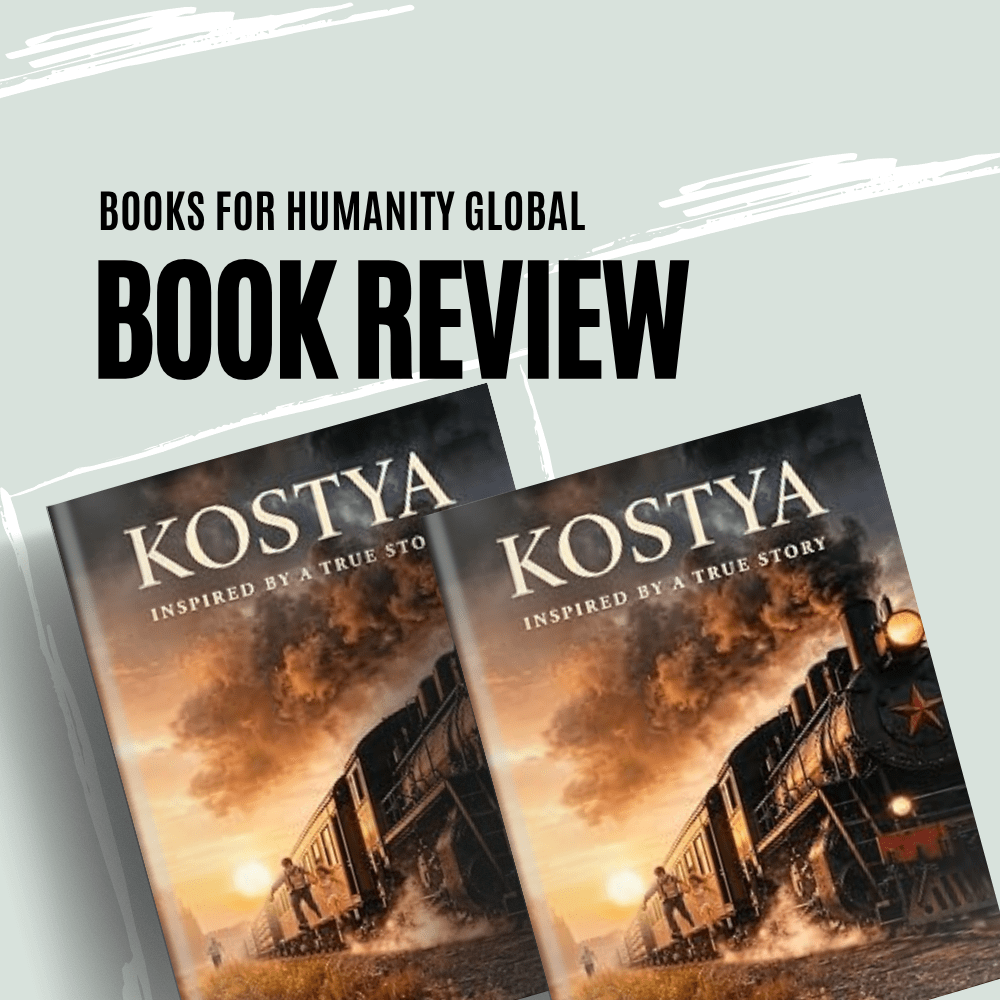
Can a rusty nail hidden beneath the ground reveal more about human character than a treasure chest? Scott Zimmerman’s KOSTYA explores a question like this. Read the full review to discover why.
KOSTYA by Scott Zimmerman
Genre: Historical Fiction
Sub-genres: Historical Adventure, Wartime Fiction, Survival Fiction, Coming-of-Age Fiction, Historical Drama
Themes: Resilience, Integrity, Family, Survival, Courage, Freedom, Identity, Love, Perseverance, Moral Choice, Human Dignity, Endurance
Content Warning: Historical depictions of famine, war, imprisonment, political oppression, death, and human suffering.
History is often measured in dates, treaties, and military campaigns. Yet most people experience history differently. They experience it through empty dinner tables, difficult choices, unexpected friendships, and the determination to make it through another day. KOSTYA by Scott Zimmerman understands this distinction exceptionally well.
At its heart, this novel follows Konstantin “Kostya” Lysenko, a young boy whose life unfolds against some of the most turbulent events of the twentieth century. Rather than focusing primarily on famous leaders or military strategy, the story examines how ordinary people tackle extraordinary circumstances. It is this perspective that gives the novel much of its power.
Scientists who study resilience frequently note that perseverance is not simply a personality trait but a process involving adaptation, problem-solving, and social connection. KOSTYA feels like a literary exploration of that idea. Again and again, the protagonist encounters situations that require ingenuity, patience, and moral clarity. The novel never treats survival as a simple matter of strength. Instead, it presents survival as a combination of judgment, character, and persistence.
One of the book’s most effective qualities is its attention to detail. The opening sections depicting life during famine immediately establish a world where every meal matters and every decision carries weight. The descriptions are vivid without becoming excessive, allowing readers to understand both the physical hardships and the emotional realities faced by families struggling to endure circumstances beyond their control.
The novel also excels at showing how large historical events affect individual lives. Readers often encounter World War II through maps and statistics, but statistics rarely explain what it feels like to leave home, face uncertainty, or wonder whether loved ones will ever return. KOSTYA consistently brings history down to a human scale.
Another strength lies in the recurring theme of integrity. Throughout the novel, characters face choices that are not easily resolved. What distinguishes the story is its willingness to explore these situations thoughtfully. The narrative repeatedly asks what people owe to themselves, their families, and their principles when circumstances become difficult. These questions remain relevant regardless of historical period.
The pacing deserves special mention. The story combines historical depth with the momentum of an adventure novel. Escapes, pursuits, dangerous journeys, and moments of suspense keep the narrative moving while never overshadowing the emotional core. Readers become invested not merely in what happens next, but in who Kostya becomes along the way.
This novel is especially suited for readers who enjoy historical fiction grounded in real human experiences, as well as those interested in stories of perseverance and personal growth. Readers seeking lighthearted escapism or purely contemporary settings may find that the book pursues a different objective. Its focus is reflection, endurance, and understanding.
What makes KOSTYA memorable is not simply its historical backdrop. It is the reminder that courage often appears in ordinary forms: keeping a promise, protecting a loved one, maintaining hope, or refusing to abandon one’s principles. Through Kostya’s journey, Scott Zimmerman offers a compelling portrait of human resilience and the enduring value of integrity when circumstances seem determined to erase both.
General Site Disclaimer
The content on the Books for Humanity Global website is for general informational purposes only. We do not provide medical, legal, financial, or professional advice. Opinions expressed in reviews and articles are those of the authors and do not represent the official views of Books for Humanity Global. We are not liable for any decisions or actions taken based on the information provided. External links are for convenience only, and we are not responsible for their content.
For more details, please read our full Disclaimer, Privacy Policy, and Terms of Service.
Your continued use of the site constitutes acceptance of our policies, terms, and conditions.
Useful Links
- About Us
- Authors for Humanity
- Blog
- Book of the Week
- Book Offers
- Book Review Request Step 3
- Book Review Requests
- Book Wish List
- Contact us
- Disclaimer
- Our Sponsors
- Privacy Policy
- Subscribe to our newsletter
- Terms of Service
- Voices for Humanity
More from Books for Humanity Global
Alisse Lee Goldenberg on Storytelling, Legacy, and the Journey Behind Her Latest Novel
Can a fictional family tree outgrow the notebook that created it? Discover how one author’s imagined world evolved across years…
Keep reading
Lessons from Timeless Books: Empathy, Trust, and Moral Action
Can a simple story, a leadership book, or a hard-earned lesson quietly reshape how someone leads and treats others? This…
Keep reading
Ways to Use Books and Learning Initiatives in the New Year to Drive Meaningful Change in Underserved Communities Worldwide
What if finishing a book mattered less than what you did with one page of it? This roundup explores how…
Keep reading
How Christmas Stories Build Empathy
Why do stories told at Christmas linger longer in our hearts—and quietly change how we treat others afterward? Read on…
Keep readingSomething went wrong. Please refresh the page and/or try again.
Discover more from Books for Humanity Global
Subscribe to get the latest posts sent to your email.

 Books for Humanity Global