
S.S. Turner is an award-winning author whose experiences have shaped his storytelling approach. With a diverse background, Turner was born in Australia and has spent significant time in the United Kingdom, the United States, and other parts of the world. His work spans across different fields, including his time as a trash collector and his travels, all of which have provided him with unique perspectives on life, identity, and belonging.
His most recent book, Golden, reflects many of these experiences. The BREW Seal of Excellence-winning piece follows Will, a man grappling with personal loss and tackling a new life in Australia. Central to the story is Will’s dog, Mia, whose companionship provides emotional grounding and helps him confront larger themes of transformation, displacement, and identity.
Turner’s creative process has been informed by his own journey of loss and rediscovery. The novel draws upon his personal experience of losing his Golden Retriever, Mia, to cancer, which inspired the central relationship in Golden. Turner’s writing explores universal human experiences through the lens of his own life, emphasizing the importance of emotional connections and personal growth.
In this interview, Turner discusses the themes of transformation, cultural challenges, and the balance between humor and serious topics in Golden. He also reflects on his writing journey and his upcoming projects, including a new novel, The Last Toll Collector, which explores similar themes of human value and survival.
With the release of Golden just around the corner, what motivated you to write this particular story about Will and Mia?
My primary motivation to write Golden was to find a creative outlet to help process my own grief after I lost my Golden Retriever Mia to cancer a few years ago.
Mia and I were super close. She was with me all day, every day, and she knew what I was thinking before I did. All dogs are amazing, but Mia was a particularly special dog and we had a uniquely connected friendship. When I learnt that she was dying from cancer at only eight years of age, I couldn’t believe it was really happening. And then when she passed away, the emotional pain was so overwhelming that I couldn’t function properly for a while. It was a brutal experience that I’ll never forget.
I’ve always believed that the most powerful writing is birthed from real emotions and authentic stories, so when I was grieving Mia’s passing I decided to harness my pain by writing a story. A year and a bit later, Golden was born.
How does the theme of transformation play a role in Will’s journey as he tackles his new life in Australia?
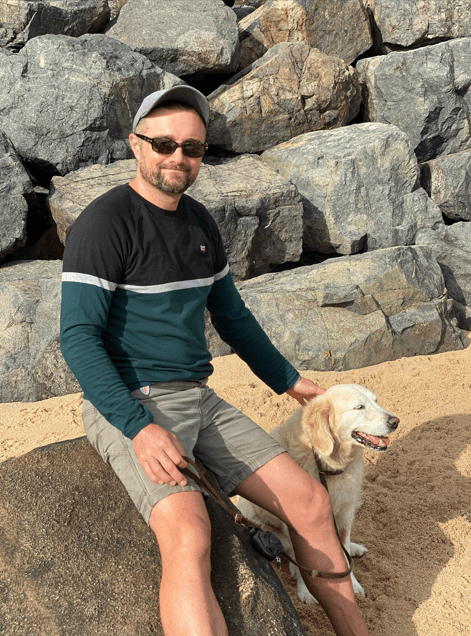
The theme of transformation is indeed at the heart of the novel. When Will arrives in Australia from the UK, he’s as lost and untethered as a person can be. Beyond his relationship with Mia, he’s adrift in a new world where he doesn’t know a single soul. His initial reaction is to look outward at the strange, cryptic community in which he finds himself to try to solve the mysteries that are clearly encircling him.
But as the story progresses, Will is forced to look in the mirror as he faces up to the harsh realities of his life. This is when his transformation process really escalates—and because he’s so lost and untethered, it’s a dramatic journey.
Can you elaborate on Mia’s character and her significance in Will’s transformation throughout the story?
At the start of the novel, Mia is Will’s best friend, parent, sibling, and child all in one. She’s his source of love, care, understanding, and stability—and they have an unspoken bond that’s unbreakable no matter what the outside world throws at them. I’d go so far as to say that their relationship is the only aspect of Will’s life that’s meaningful. I think a lot of dog owners will relate as dogs have this way of making everything ok by loving us as though we’re much better than we really are.
Without giving away any plot spoilers, all I can say is that Mia’s journey forces Will to take responsibility for his own transformation into the type of man he’s always wanted to be.
What aspects of your own experiences in Australia influenced the cultural elements and challenges depicted in Golden?
My own experiences in Australia certainly influenced the cultural elements and challenges portrayed in Golden.
By way of background, I grew up in Australia with English family, then I spent most of my adult life living in the UK and travelling Europe and the US extensively for work. As is the case with many long-term travellers, I found myself during my two decades of globetrotting. But I also lost my sense of national identity, confirming the often quoted theory that once you leave where you grew up, you never feel like you totally belong there again. So I became a global citizen who was at home everywhere, but of course not really at home anywhere.
My wife Jess and I made the decision to relocate to Australia from the UK a few years ago. When I returned, I was a very different person to the boy who’d left. I’d grown more confident and I’d found my voice through all those years of exploring the world.
I’ll never forget the first couple of years of settling back down to life in Australia. My accent was decidedly global and un-Australian, so I was treated as a foreigner. That was challenging, but the silver lining was it allowed me to get to know the country again with the benefit of the broader perspective only outsiders are gifted.
What I experienced surprised me in both good and bad ways.
On a positive note, I’d forgotten how stunning the country’s beaches, bushland, wildlife, wide open spaces, and climate are. It’s hard to describe the feeling of waking up on a warm sunny morning to the contagious laughter of a kookaburra with the earthy smell of nature filling the air. After living in a cold, dark climate for so many years, I loved it.
On a more negative note, I encountered some racism, close-mindedness, and an endemic lack of empathy for others that was challenging to accept. This reality couldn’t have been more at odds with the relaxed, friendly image of itself Australia sold to the rest of world, or the national self-identity that still seemed to resonate with so many locals.
Readers will notice similar themes throughout Golden. The story was always intended to be born out of truth.
What were some of the most significant challenges you faced while writing Golden, and how did you address them?
My biggest challenge when I wrote Golden was that I started out including a few unnecessary subplots.
I was once given some great advice on how to tell if a subplot should stay or go, otherwise known as the leg of the table test: if you remove a subplot from a story and the main plotline is unaffected, then the subplot really shouldn’t be there. In other words, all subplots should connect to and significantly add to the main plot, thereby earning their place in the story.
So my challenge was initially incorporating a few subplots that failed the leg of the table test. That meant these superfluous storylines were only serving to complicate and dilute the power of the core Will-Mia storyline.
Only when they were edited out of the book did it become apparent how much they’d been holding the story back. Hello humble pie. Hello the delete key.
Golden blends humour with serious themes. How did you balance these tones while addressing topics like displacement and identity?

I think a lot of people find cultural misunderstandings inherently funny. So the story of a man and his dog relocating from the UK to rural Australia offered a treasure trove of funny stories to call upon—and call upon them I did. I felt uniquely qualified to do so having spent half my life in Australia and half in the UK.
For example, at the start of the novel, the protagonist Will is queuing up for a taxi with the sensitivity and expertise the British are famous for when they’re queuing. But to his dismay, he soon discovers that the Australian technique is far pushier and unaware of others. It’s funny because it’s true.
Behind the humour, many of the novel’s themes are indeed more serious. I think this is true to the relocation experience. Once the gallows humour ends, you must contend with the harsh realities of life in your new chosen home without the support network you may be used to. In Will’s case, I wanted his support network, which is effectively his stepfather, to be unreliable so as to ramp up his sense of displacement. As a result, his experience of relocating to Australia is particularly raw and honest—both at the surface and emotional levels.
I think the balance between the novel’s humorous and serious themes derives from the authentic, truthful nature of the stories that connect the laughter and the crying—often by the slimmest of margins.
Receiving the BREW Seal of Excellence this month is a notable achievement. What does this recognition mean for Golden and your writing journey?
Thank you for this! I’m honoured to receive the BREW Seal of Excellence and hope it marks a wonderful step forward in my writing journey.
Are there particular scenes in Golden that you feel strongly convey the book’s central themes of growth and belonging?
One of the novel’s recurring scenes relates to Will’s new job in Australia as a trash collector. It was the only job he could get and it tests his determination to create a new life down under.
Before work each morning, Will must stand around in a circle with the other trash collectors for morning training. During these sessions, Will’s colleagues often insult him for being different and foreign. They don’t even try to hide their disdain for his Britishness.
At first, Will hates being vilified like this as it highlights to him that he doesn’t belong where he is. But as the novel progresses and he grows as a person, Will’s response to his colleagues’ mean-hearted banter transforms, as does his belief that he’s worthy of belonging.
I think a lot of readers who were bullied at school will relate to this aspect of the story. It’s at the moment when your bullies lose their power over you that you can stand up and be counted as the real, authentic you.
How do you believe stories like Golden can help readers face their own challenges and experiences of transformation?
I recently read a great quote about all forms of art: ‘Art should comfort the disturbed and disturb the comfortable.’ I one hundred per cent believe this applies to writing.
I’d imagine books like Golden could well comfort the disturbed and disturb the comfortable. In particular, readers who are feeling lost and struggling to find their place in the world, may well find themselves in the pages of Golden—hopefully including during the transformation process.
After the release of Golden, what can readers look forward to in your future writing endeavors?
There’s news to report on this front…
By way of background, I wrote Golden three years ago, and it was originally due to be published at the start of 2024. For various reasons, the launch was delayed by my publisher until October 15th. While this was all happening, I spent a couple of years working on another book which I recently finished. I was keen to work with a different publisher with this one, so I decided to test the water by sending the novel to a few publishers.
Thankfully, this novel was quickly signed by a great UK publisher, and they’re so enthusiastic about it that they’ve committed to publishing it ahead of Christmas. So I’ll be launching this next novel within a few weeks of the launch of Golden. Lesson learnt: publishing is like buses. You write for years and then everything gets published at once.
This next novel is called The Last Toll Collector. It’s the story of Valerie Tobruk, who was a toll collector on the Golden Gate Bridge until toll collection was automated in 2013. Since then, she’s struggled to find a job which AI can’t do better than her. She feels useless and lost.
To escape from the unhumanness of her life, Valerie travels to the Westfjords, a remote part of Iceland where people go to disappear and nature reigns supreme. Once there, she discovers an abandoned herring factory and village where she decides to reside as the founder of a new independent nation called Tobruk where people are valued for their humanness.
Valerie doesn’t remain alone for long. A cast of lost souls soon descend upon Tobruk, as do a series of perplexing challenges presented by the outside world. But there’s worse to come. When the darkness of winter descends, the citizens of Tobruk must face up to their deepest fears if they are to survive.
Readers interested in the launch of The Last Toll Collector can connect follow me at: https://ssturnerblog.com and https://x.com/SSTurner7. Golden is on Amazon and Goodreads.
Useful Links
- About Us
- Authors for Humanity
- Blog
- Book of the Week
- Book Offers
- Book Review Request Step 3
- Book Review Requests
- Book Wish List
- Contact us
- Disclaimer
- Our Sponsors
- Privacy Policy
- Subscribe to our newsletter
- Terms of Service
- Voices for Humanity
Discover more from Books for Humanity Global
Subscribe to get the latest posts sent to your email.

 Books for Humanity Global
Cultural misunderstandings are super funny! I really loved the quote the author used about art. The author’s next story sounds sad, though.
LikeLike